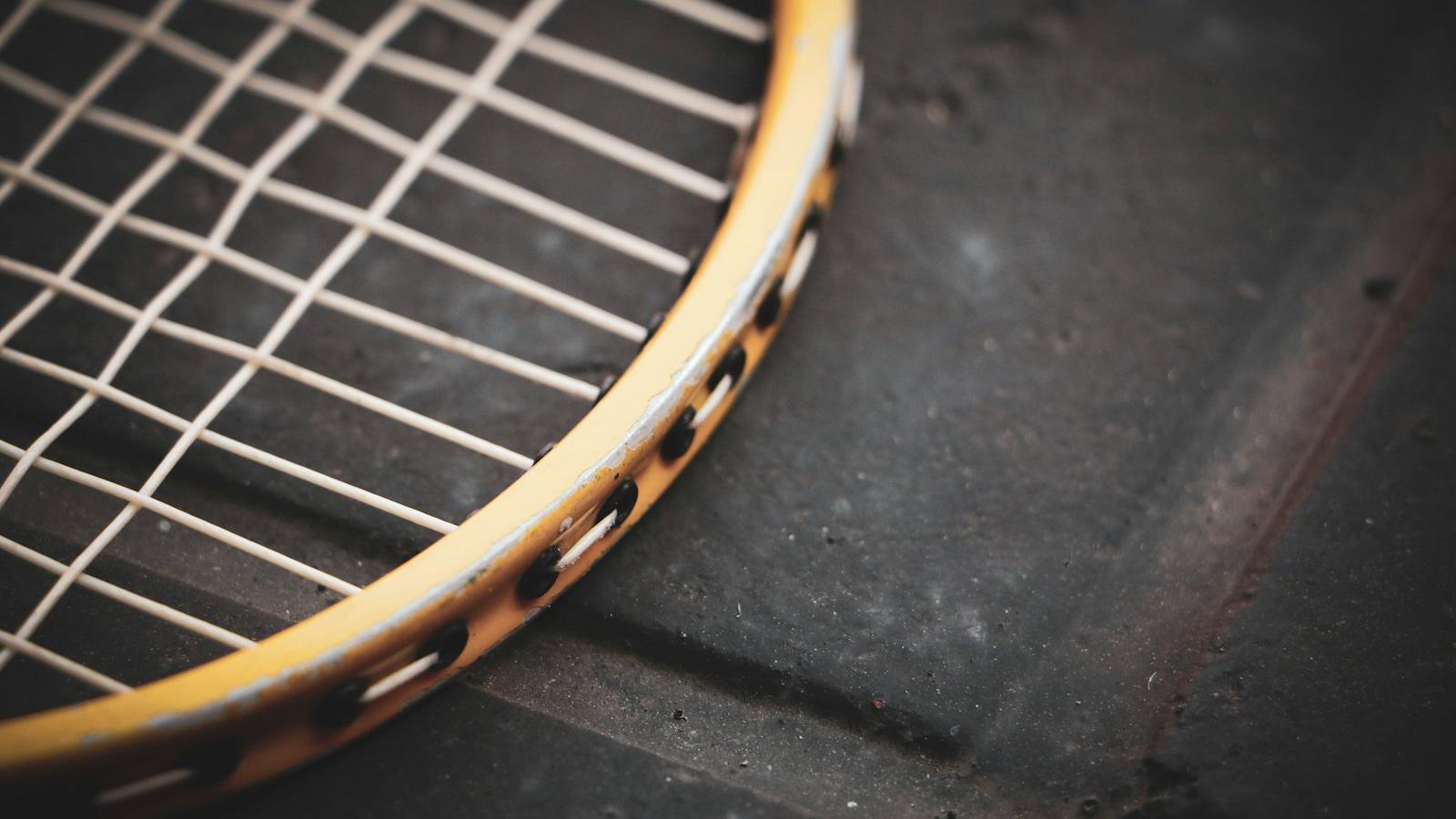
Specifications as listed by Tennis Warehouse. This frame is not yet in the lab measurements Racket Fit uses.
The result
Mirra Andreeva won the FAGE WTA Finals on Saturday 15 November, beating Elina Svitolina 7-5, 6-3 in one hour and 48 minutes. According to the WTA report on the final, she won all five of her matches in the week without dropping a set, 61 games to 26 in total. At 19 she is the youngest champion of the event since Maria Sharapova in 2004. It was her fourth title of the year after Adelaide, Linz and Roland Garros, which ties her with Elena Rybakina for the most on the tour this season.
This article looks at the equipment: what she is reported to play, what the closest shop racket is, and how the frame and strings measure in the lab data Racket Fit is built on.
The frame: a Wilson pro stock under Blade paint
The most detailed public account of her setup is Tennisnerd's profile of her racket, last updated in June 2026. It reports that she plays a Wilson pro stock frame in Blade paint, built on the mold of the old Wilson Steam 100, which Wilson has since released in shops as the Blade Pro 100 v10. Tennisnerd also reports four strips of lead tape at 12 o'clock, at the very top of the head.
Two cautions apply. Tennisnerd says it does not know her exact specs or her string tension, and nobody has published a stringing sheet for the WTA Finals. So this describes her known setup in general, not a confirmed record of the final. We also found one other site naming a different brand of racket for her. We could not reconcile the two, so we follow the more detailed and more recently updated source and leave the other claim out.
The shop version: Wilson Blade Pro 100 v10
Tennis Warehouse lists the retail Blade Pro 100 v10 with these specifications: a 100 square inch head, a 27.25 inch length, a strung weight of 309 grams, a balance of 33.02 cm (5 points head light), a swingweight of 318, a stiffness of 68, a constant 23 mm beam and a 16x20 string pattern, with a recommended tension of 47 to 57 lbs. The extra quarter inch of length over a standard 27 inch frame adds reach and a little more swingweight for the same mass.
This particular frame is not yet in the Tennis Warehouse University measurements our database uses, so we cannot show lab figures for it. The nearest measured frame is the standard Wilson Blade 100 v10, a different, more flexible layup in the same family:
| Measurement | Blade Pro 100 v10 (shop listing) | Blade 100 v10 (lab) | Median of 148 frames with 100 sq in heads (lab) |
|---|---|---|---|
| Strung weight | 309 g | 318 g | 318 g |
| Balance | 33.0 cm | 33 cm | 33 cm |
| Swingweight | 318 | 319 | 319 |
| Stiffness (RA) | 68 | 61 | 65 |
| Twistweight | not listed | 14.2 | 14.6 |
Shop listings and lab measurements are taken differently, so the first column is a guide rather than a like-for-like comparison. Even so, the picture is clear. In weight, balance and swingweight the Blade Pro 100 is an ordinary 100 square inch racket, slightly lighter than the middle of the group. Where it stands out is stiffness: a listed 68 against a lab median of 65 and the 61 measured for the standard Blade 100. Tennis Warehouse puts this down to its thicker beam, which it says gives the racket a crisp feel and adds power compared with the rest of the Blade family.
What four strips of lead at 12 o'clock do
Tennisnerd does not say how heavy each strip is, so we cannot give her finished specs. The direction of the change is still easy to work out. Weight at the tip of the head is the most effective place to raise swingweight, because swingweight grows with the square of the distance from the handle. Using the same formula as the Racket Fit Mod Lab, every gram at 12 o'clock adds roughly 3.4 points of swingweight to a standard length frame, a little more on a 27.25 inch one, and it also moves the balance towards the head.
Heavier swingweight means the racket carries more momentum into the ball and is pushed around less by heavy hitting, at the cost of being slower to swing and to bring round on returns. Adding it only at the tip, rather than at 3 and 9 o'clock, raises swingweight without doing much for stability on off-centre hits. If you try this, add tape a gram or two at a time and play a few sessions before adding more.
The string: Luxilon ALU Power
Tennisnerd reports a full bed of Luxilon ALU Power, possibly the Rough version, and says she previously used Luxilon 4G. Here is how those strings measure in the Tennis Warehouse University string test, which our string data comes from:
| String | Stiffness (lb/in) | Tension loss | Spin potential |
|---|---|---|---|
| Luxilon ALU Power 125/16L | 209.2 | 46.6 | 5.8 |
| Luxilon ALU Power Rough 16L (1.25) | 209.2 | 39.6 | 6.5 |
| Luxilon 4G 16L (1.25) | 258.9 | 21.3 | 3.9 |
| Median of 482 polyester strings | 201.2 | 41.2 | 5.3 |
Lower tension loss is better. ALU Power sits close to the polyester median for stiffness and above it for spin potential, with the Rough version scoring higher on spin and holding tension better than the smooth one. The move away from 4G is a move to a much softer string: 4G is about a quarter stiffer than ALU Power in this test and holds tension far better, but scores well below the median for spin.
What a club player can take from it
The base frame is a shop racket you can buy, and its numbers are not extreme. The two things to think about are the stiffness and the lead. A stiffness of 68 is at the firm end of the range, and lead at the tip makes the racket swing heavier than its static weight suggests. Both suit a fast, full swing.
If you like the idea but want a softer feel, the standard Blade 100 v10 measured at 61 RA in the lab with almost the same weight and swingweight. ALU Power is close to a typical polyester by the lab stiffness figure, and the smooth version loses more tension in the test than the median, so it needs restringing more often than its feel when new suggests.
Check your own numbers
Every lab figure in this article can be looked up in the Racket Fit comparison tool. You can try the effect of lead tape on a measured frame in the Mod Lab, and the fitting asks a few questions about how you play and ranks frames and strings from the same lab data.
Sources
Want a personalised recommendation for your game?
Start the fittingFree, two minutes, no account needed
More guides
 news
What Carlos Alcaraz won the Paris Masters with: Pure Aero 98 and RPM Team
The racket and strings Carlos Alcaraz is documented to use, how close the retail Babolat Pure Aero 98 is, and what the lab measurements say about both.
 rackets
New Tennis Rackets of 2026, Measured: Wilson Defyer, Yonex Muse, HEAD Extreme and Prince Tour
Four racket lines arrived in 2026. Here is what each is for, and what Tennis Warehouse University measured for swingweight, stiffness, twistweight and power on every model.
 rackets
Wilson Python 98 — First Look at Wilson's New Pro Stock Frame
The Wilson Python 98 is Wilson's new unreleased pro-stock frame with a unique 16x20 string pattern, 302g unstrung weight, and RA 65 stiffness. Here's what the specs tell us.